
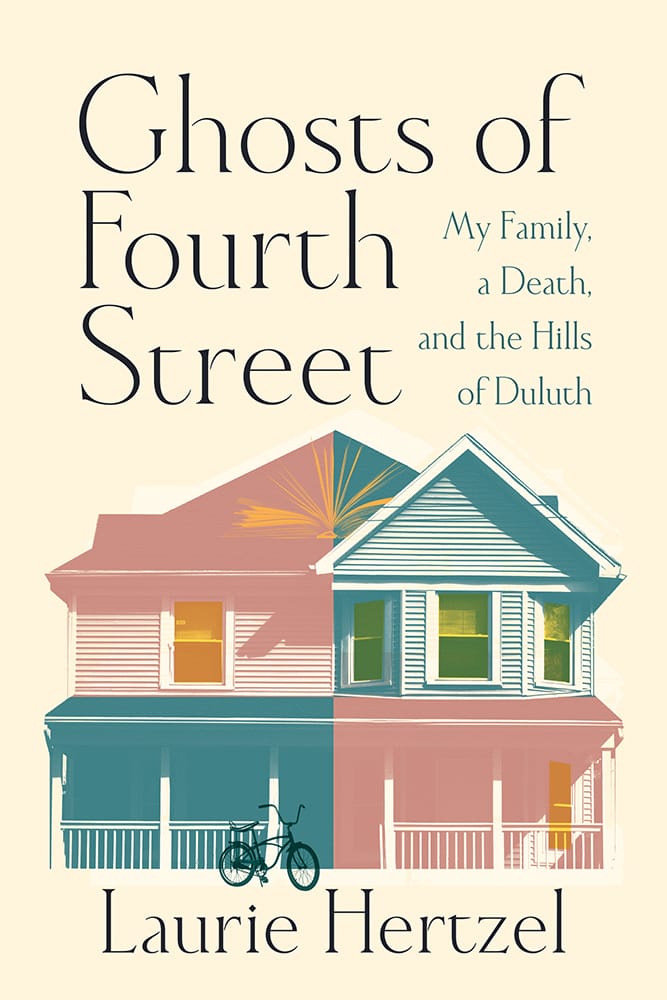
The Year Bobby Died: A review of Ghosts of Fourth Street by Laurie Hertzel
by Jill Swenson
In a two-story house on a hilly, tree-lined street in Duluth lived an English professor, his wife, and their ten kids. In the middle of the family mayhem was a shy and observant girl named Laurie. Her eldest brother, Bobby, drowned the summer after he turned eighteen in 1966, and thereafter the family referred to him by his baptismal name, John Patrick.
Ghosts of Fourth Street is Laurie Hertzel’s new memoir about the year her brother died. In the prologue, Hertzel discloses why she felt compelled to write about what happened.
My family didn’t talk much about Bobby after he died, and I came to understand that it was somehow inappropriate. That we’d be better off if we just changed the subject. But I thought about him a lot. And I thought about the silence. I wondered – isn’t it better to talk than to hide? To open doors rather than to close them? What happens to stories if we don’t tell them? If we don’t talk about Bobby, will he be forgotten? If we don’t talk about the day he died, how can we explain how we became who we are?
Except for the prologue and epilogue, Hertzel narrates from her perspective as a nine-year-old. Her clear-eyed observations are without analysis or interpretation, leaving room for readers to make their own judgments. The voice of a child narrator is constrained by her limited understanding of the world, yet grants her greater freedom to express the truth plainly.
This vignette from a winter afternoon in Duluth illustrates how Hertzel effortlessly gains the reader’s trust in her child protagonist.
Outside our front picture window was nothing but snow, and I decided to put it to good use and build an igloo. The Eskimos did it by cutting squares of ice and stacking them, so I sneaked a butter knife from the kitchen drawer, pulled on my gigantic parka, and went out into the glittering white yard. With the butter knife, I sliced through the snow, but cold as it was, it was not cold enough. The snow crumbled and wouldn’t hold and I grew frustrated—why won’t this work?—but I kept at it, hacking away at the yard, the blocks breaking into small pieces, like Styrofoam, and after a while the knife slipped from my numb fingers and disappeared two feet through the snow to the frozen invisible ground. I dug for it, panicking; nobody knew I had borrowed it, I was messing around where I shouldn’t be, taking things that didn’t belong to me! My breath came faster, my mittens were soaked, the snow was all up my sleeve and down my boots, I was shivering, I could not find the butter knife, I was going to be killed.
A missing piece of silverware meant big trouble, though adult readers know it unlikely her parents would wish her dead. Hertzel lets the reader infer this child knows nothing yet about death.
“For the telling of certain stories, the way a child sees things—and the way in which that child’s manner of seeing transforms the things being seen—provides the clearest possible lens,” Jeannine Ouellette wrote in “That Little Voice: That Outsized Power of a Child Narrator,” (Assay: A Journal of Nonfiction Studies, 9.2, Spring 2023). This intimate family portrait of complicated grief is such a story.
The absence of an adult narrator makes the reader feel a direct and personal connection to her honest eyewitness account. With the exception of the Prologue and Epilogue, Hertzel writes scene after scene entirely from her perspective as a younger version of herself – this woman who first became a journalist and would never make things up.
There is no dramatized drowning scene because she was not there. What might be considered a limitation to first-person POV narration – the reader only knows what the child witnesses – becomes in Hertzel’s hands a strength to crafting an accurate story. She uses it to stay physically grounded in her own experience and evoke in the reader the complicated emotional reaction as true. Her vantage point gives structure to the story so the reader can experience what she had: his absence.

The memoir consists of two sections. The house on Fourth Street comes to life in the first section, Old Ghosts, under the commands of “Guv,” her father, and her mother, Trish. That the Hertzel kids called their parents by their first names was one more way Laurie noticed her family was different from other families. She captured the way children find their parents mysterious, curious about who they were, where they came from, and what about their childhood still haunts them. Pretending to be a spy, she follows her father to see if he had another family somewhere or a secret place where he went without the rest of the family. She stalks him on his daily walks through the neighborhood streets of Duluth. Her siblings say her father stomped on Bobby’s glasses because he left them laying on the floor one too many times. Her mother kept silent about her secret sorrow for a brother killed in combat and parents who moved away because they could not bear to live in her childhood home where he had grown up.
The second section, Future Ghosts, starts before Bobby drowns, when he begins to disappear from family life at home, avoiding confrontations with his father. Bobby slept late, skipped school, and wrote beat poetry on his rescued typewriter, burying himself in his basement bedroom. He graduated, but had no plans to get a job or attend college. He went water-skiing one June day. And then, he was gone.
Haunted by sorrow, the family on Fourth Street was forever changed. “We just kept going. Everyone got out of our way.”
In the final chapter, aptly titled, “And Then,” Laurie and her younger brother, Evan, are in the kitchen making cookies during a winter storm blowing in off Lake Superior. She reads a book while Evan mixes the dough. “Everyone else was upstairs, behind closed doors, as far away as they could be, or gone…it felt as if the entire house was going to fly apart.” While reading the story aloud to Evan, Laurie made a mistake, saying gravy instead of gray, which made no sense. “We began to laugh, and laugh, and laugh, until I was doubled up in pain, my arms across my stomach, wheezing with delight and despair, and Evan dropped the cookie spoon and slid down the wall onto the floor, where he lay laughing until we both wept.”
Life went on and Laurie Hertzel spent eighteen years working at the Duluth New Tribune. Her first memoir, News to Me Adventures of an Accidental Journalist (2010), was about her coming-of-age experiences in the male-dominated field of print journalism. She retired after working fifteen years as the book editor at the Star Tribune in Minneapolis and served two terms on the board of the National Book Critics Circle. Currently, she teaches in the low-residency MFA in Narrative Nonfiction program at the University of Georgia in Athens.
For sixty years, her memories remained private. She never stopped thinking about her brother and that little girl she used to be. She couldn’t not write about the year her brother died. She spent years trying to make sense of it all. For more than a decade, the manuscript sat in a drawer. After her mother discovered Laurie had published a personal essay in a small literary journal, she was angry and hurt and never spoke to her daughter again. John Patrick’s death was a private family matter.
Bobby lives on the pages of his sister’s new memoir. Reclaiming his memory and the family stories fills the empty space where he once fit in family life. Ghosts of Fourth Street will be released on May 2, 2026 from The University of Minnesota Press.
Jill D. Swenson grew up in the Twin Cities and moved to Wisconsin in high school. She graduated from Lawrence University and earned an MA and PhD from The University of Chicago before going on to teach journalism and media studies at the University of Georgia-Athens and earn tenure at Ithaca College. For a decade she lived off the grid on a small-scale sustainable farm in upstate New York; now she lives in Appleton, Wisconsin, where she works as an editor and literary consultant, belongs to a curling club and a poetry group, and enjoys walking her dog.