
Grief, Acceptance, and Everything Else that Comes in Waves
by Blair E Vandehey
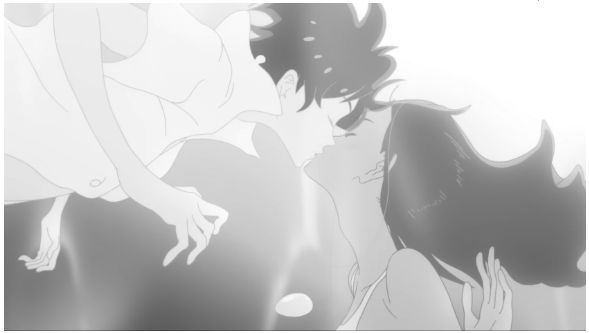
A rescue from a burning building brings Hinako (Rina Kawaei), a surfer, and the firefighter Minato (Ryôta Katayose) together, the former offering to teach the latter to surf as thanks. The two quickly end up falling for one another, and the following year passes in an instant as they build a relationship together. Their blossoming romance, however, is cut tragically short when Minato’s impromptu beach rescue of a drowning jet skier goes wrong, leaving a grieving Hinako to pick up the pieces of the life she had created with him. Shortly after, she begins to see him in water, from a glass at a cafe to her bathtub, which leads her to fight an internal battle of holding on and moving on. Directed by Masaaki Yuasa, Ride Your Wave depicts a story of those closest to Minato as they learn to navigate the many shades of grief until they eventually are able to ride their own wave once again.
Even considering the foreshadowing from his history with the ocean to his overly self-sacrificial inclinations, Minato’s untimely death still comes as a shock to the audience thanks to how Yuasa chose to portray its unexpectedness. The fateful day gives off the semblance of normalcy as it switches between two points of view, with Hinako working at the flower shop and Minato hitting the waves as any usual day might pass. However, that regularity is slowly punctured when the scene begins to snap quickly back and forth between the emerging chaos at sea and the quiet content of Hinako, oblivious to the tragedy unfolding as she goes about her daily duties. This juxtaposition between the two points of view brings to light the dramatic irony of a world-changing event happening quickly and unremarkably. The audience therefore experiences Minato’s death at the same bewildering pace that it happens in the film, leaving them empathetic to Hinako’s shock when she later finds the dive team covering his body. ‘The Usual’ proves to be Yuasa’s greatest artistic weapon as he gutpunches both characters and audience with this twist, the tactic appearing even beyond the scene in newly-discovered texts waiting in the message bar that Minato never sent and Christmas grams recorded ahead of time reaching Hinako far too late.
Procession of grief has no one-size-fit-all look, and Ride Your Wave reflects that nuance with unmatched authenticity. Hinako copes (and sometimes fails to cope) differently as time goes on, from moving far from the seaside, to losing the will to function. to feeling betrayed (and then feeling guilty for feeling betrayed) that Minato left her, to outright denial when she starts to see him in water. Minato’s sister Youko’s (Honoka Matsumoto) hostility towards others amplifies as she tries to distance herself from reality, putting on an uncaring front. His best friend Wasabi (Kentarô Itô) develops a trauma-induced inferiority complex as he tries to live up to Minato’s hopes that he would become a firefighting hero. Grief’s impact in Ride Your Wave extends farther than those directly affected; there are scenes in which Hinako’s friends struggle to understand what their friend needs in this experience, the ripple effect reaching far beyond just people who knew Minato personally. These diverse reactions reflect the genuine nature of the grieving process’ individuality.
Minato’s post-death interactions with Hinako blur the line between psychological and supernatural, with hints at both explanations ultimately landing Ride Your Wave in the gray zone between the two. Scenes which point to Minato’s appearances as a result of Hinako’s inability to move on, such as when Wasabi sees her talking to an empty water bottle, conflict with scenes in which Minato appears to put out a fire in a building threatening Hinako and Youko’s lives, controlling nearby water with some otherworldly force. Rather than giving us a black-and-white answer, Yuasa poses the balance between the two not dichotomically but as a spectrum, the answer falling somewhere on a continuum rather than being one or the other.
Towards the end of the film, Hinako discovers the truth about an incident years ago that reveals Minato was already living on borrowed time when she met him and that without one lucky coincidence, he wouldn’t have even formally met her. Had things played out differently, Hinako would have gone her whole life without knowing the joy he offered her. It is with this realization that Ride Your Wave implies its main message: even though their story ultimately ended in heartbreak, that does not make the time they did spend together any less meaningful. Left with this final message, the grieving characters of the film find their closure in having forged new relationships with each other and rediscovering their own strength to paddle back out to sea even after the perfect wave has passed, both literally and figuratively.
Blair E. Vandehey is an Appleton-based writer, daydreamer, and lover of all things pop culture. She is currently working towards degree in Creative Writing and Political Science at Lawrence University.


