Retrospect in Reverse Lang Leav’s Self-Love for Small-Town Girls
by Blair E Vandehey
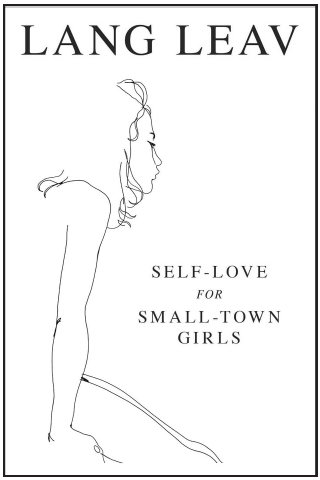
Lang Leav’s Self-Love for Small-Town Girls consists of “moments that have left me feeling enlightened in some small way” as the poetry collection traverses conflicting emotions and blurred lines of her last two decades only to end up in her own page-permeating self-assurance.
Lang Leav’s Self-Love for Small-Town Girls is a story of reflection, with Leav reminiscing on where she was, how she understood that place, and how far she has come from there. In most pieces in the collection, she speaks about herself not as an actor in the middle of a scene but from the observing audience. Because of this, the works in which the tense switches to present are some of Leav’s most powerful; she reinvents selfishness as an act of self-care in each poem where she speaks of where she is and where she–not anyone else, but she–will go (the answer of which is always anywhere, as long as she’s the one deciding).
The pronouns in Self-Love for Small-Town Girls are the best example of the work’s enigmatic ambiguity. Any number of people could be on the other end of Leav’s words in works such as “Those Who Know,” in which our author expects time to heal “you” since this “you” has bravely acknowledged the measure of whatever has been lost. Could this person be someone Leav has loved who she wishes the best for? Or maybe the reader as Leav acknowledges their own strength from a point of experience? What about an earlier version of Leav herself who stood at the cusp of her quest for inner peace? Likewise, in “Culture of Silence,” Leav speaks to a “she” who grew up in a world that condemned “her” acknowledgement of an evil act’s happening rather than the evil act itself. In a world still so dominated by patriarchal principles, “she” could easily be as large as a stand-in for womankind as a whole or as small as being a snapshot of Leav’s own life.
Even in first-person pronouns there is ambiguity. At the beginning of Self-Love for Small-Town Girls, Leav addresses her readership, hoping that at some point in the collection, “...we will find ourselves on the same page.” In “Every Scrap of It,” Leav exalts in the realization that she doesn’t owe anyone an explanation–not even herself–for the way she chooses to exist, nor is her self-worth dependent on these choices. Throughout the poem, Leav refers to herself, using first-person “I,” “my,” and the like. However, in Self-Love for Small-Town Girls’ spirit of fellowship within the word, there is no doubt that Leav wrote this poem not only as a reflection of her own story but as a mantra for her readers. Her claims of self-determination, such as “I didn’t need anyone’s permission…to gather up my entire life in my arms and own every last scrap of it” are hers, and yet not hers alone; this poem and so many other of Leav’s self-love vignettes belong also to the reader as encouragement to take back their own lives just as she has.
Nuance in Self-Love for Small-Town Girls continues to show itself in Leav’s emotional complexity. These feelings are best summed up in her poem fittingly titled “Complex Emotions:” they are “delicate…vast and wide ranging, made up of layers upon layers…often conflicting.” There is no better case of this than in the way Leav approaches bygone romantic love; in the span of the collection, she yearns for, rebukes, reveres, regrets, and shows indifference towards the romances she’s experienced, sometimes even at the same time. Her emotions towards the subject clash with every turn of the page, and yet often end up coexisting. “Loving Me” is one of the most explicit examples of Leav feeling everything at once; at the same time she worships the time she spent in love, she simultaneously rejects it in her life but also acknowledges it as an integral learning experience to her growth. There is friction in these sentiments, but also dimension–one can dislike something and still be grateful it happened all at once. Even on a black-and-white page, Leav and her collection exist on a continuum, just as we humans all do.
Beyond the 20 years of soul-searching it took her to start to articulate who ‘Lang Leav’ truly is, there are many more reasons she considers Self-Love for Small-Town Girls to be her most intimate work yet. Each poem, both those that regard the past and those of which welcome the future, overflows with human authenticity which recognizes lives and experiences far beyond just hers. There is no telling what future works may bring with Leav’s new understanding of who she might be, but there is no doubt she will continue to chip away at the rough around the diamond until she finds herself beneath.
Blair E. Vandehey is an Appleton-based writer, daydreamer, and lover al all things pop culture. She is currently working towards degree in Creative Writing and Political Science at Lawrence University.