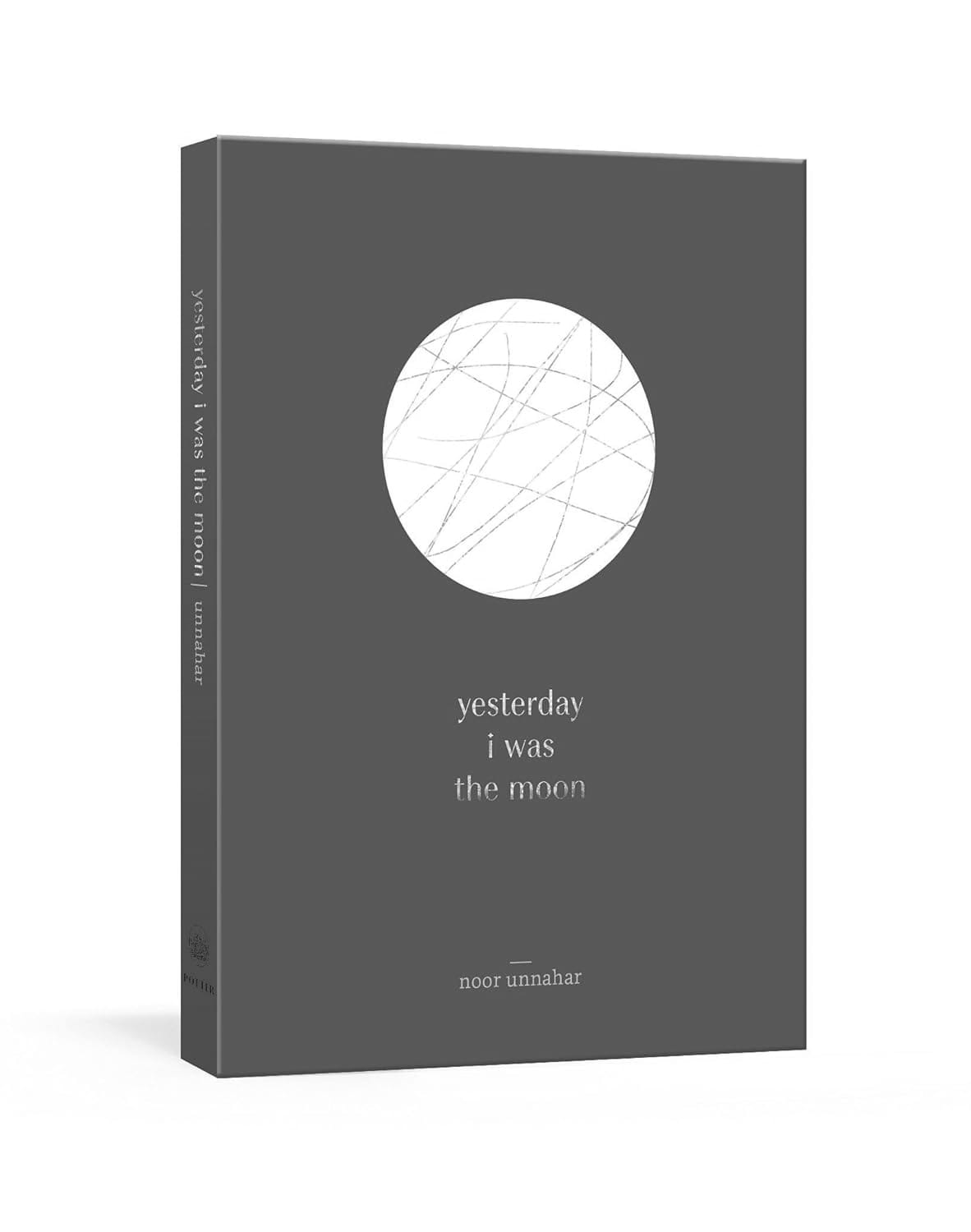
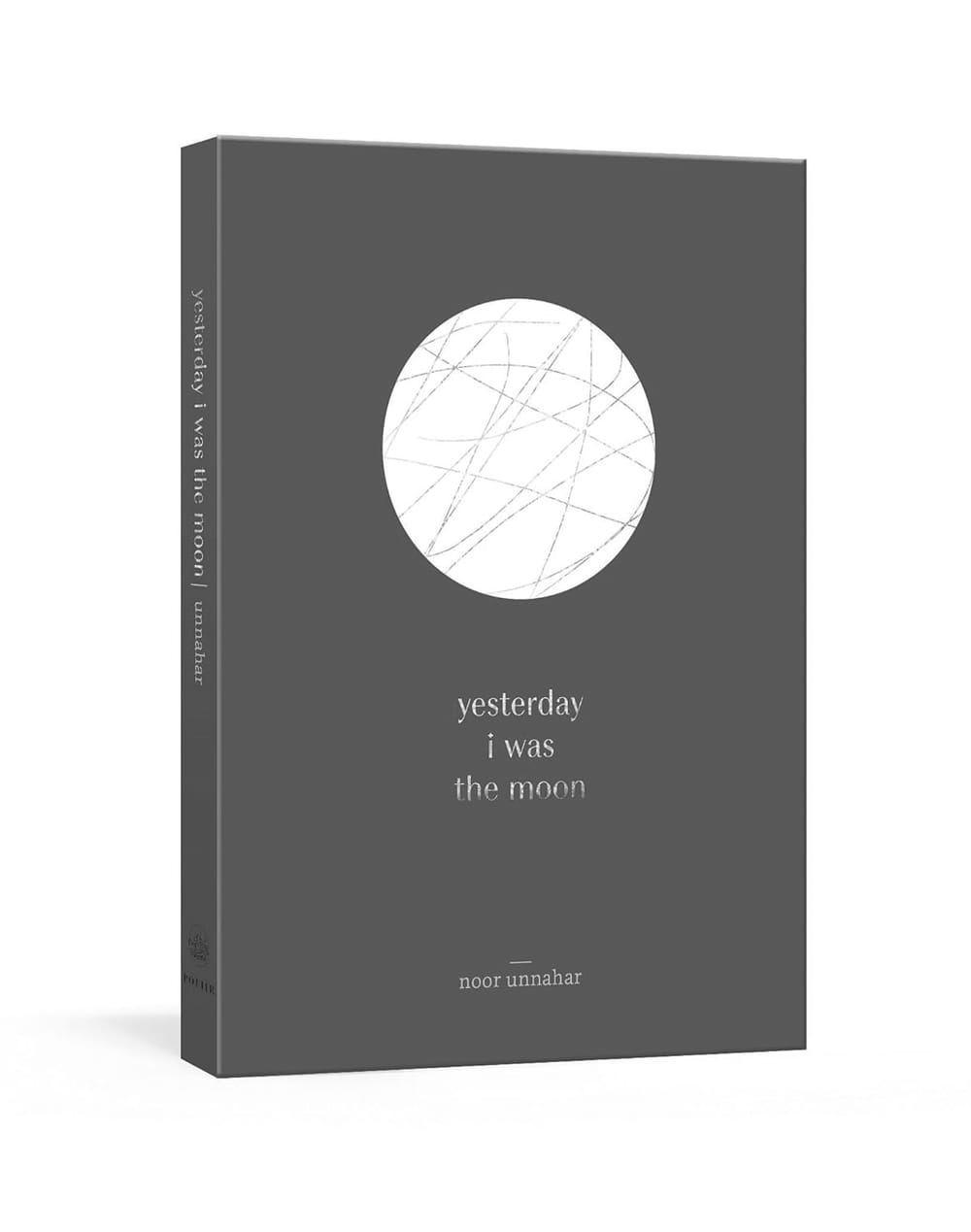
Book Review: Recollecting, Rebuilding, Reclaiming: yesterday i was the moon.
by Blair E Vandehey
A fitting beginning to a book titled yesterday i was the moon, Noor Unnahar’s debut poetry collection opens with the words “yesterday–i was the moon / today–just an eclipse,” highlighting the looming duality ahead in the pages–the darkness and light, the highs and the lows, the homesickness and the overdue return to oneself. That’s why everything in yesterday i was the moon begins with the prefix re-, or ‘again,’ as she reframes, rebuilds, recollects, reclaims her shattered–and yet sparkling–mosaic life.
Often, poets treat hardship as something to get through. Obstacles are considered unintentional and barriers on the journey are just byproducts of the world outside our control, so why approach them in any way but that? Unnahar reframes them in yesterday i was the moon, however, as integral parts of a journey; she treats them not as something to get through but as something to accept and learn from. Throughout the collection, she welcomes heartbreak in so she can understand why it knocked on her door and shakes hands with defeat, thanking it for teaching her how victory is not achieved. When it is time for heartbreak to be sent away or to turn her back to defeat, she is able to see a clearer path ahead. Rather than working around darkness like so many other poets, Unnahar learns to work with it so the light at the end of the tunnel will one day shine just a little brighter.
yesterday i was the moon is a largely retrospective collection, with Unnahar reflecting on the disasters that have wreaked havoc on her life and now deciding how she will proceed with the pieces scattered at her feet. Her words are the first deep breaths in “the peace after wars / the calm after storms” and the ashy moments of silence before the phoenix rises again. Yet, she doesn’t let this vulnerability be her weakness; she highlights the coexistent fragility of the damaged post-war building with the fact that it remains standing even through the violence. And Unnahar, graceful but determined, understands in this collection that the future awaits her, and she can either remain in her brokenness or piece together the shards. With no place to go but forwards, yesterday i was the moon tells a story of a crossroads, where our author has served her time in the first four stages of grief and is finally ready to accept the invitation to rebuild.
There is no doubt that there is an unmatchable strength in Unnahar’s words. Yet, she does not let those who helped foster it within her remain unacknowledged; yesterday i was the moon is also a tribute to the women in Unnahar’s life who nurtured her power to reclaim her life. She first speaks of her mother, whose name means ‘the sun of the women,’ for giving her a little bit of her unending glow so Unnahar can “shine when i want to…burn when i have to.” And burn at times she does, for her next informal dedication extends to the women before her who could not embrace their fiery feminine rage for themselves but have created a world where Unnahar can. That same fire is seen in her poem {women of my family}, where she recognizes the “fire dances / with their cooking pans” and the power in their domestic perseverance.
Finally, she returns to the sun– her mother, the source of all life as she knows it–and reflects on the name she bestowed upon her–Noor Unnahar, ‘the light of day’–and how to this day she carries that spark as the catalyst for the wildfire within her as it continues to grow.
yesterday i was the moon often uses the motif of the city to address Unnahar’s identity conflict. Throughout the collection, Unnahar reflects on her Pakistani home–her roots–with the thousands of foreign city streets she has traversed as a nomad. At times, both feel like home, sometimes one or the other does, and at others, neither. Unnahar faces a world–and the cities of it–that sometimes does not accept her in full. In her poems {namaz} and {hijab}, she wrestles with the comfort and pride she finds as a Muslim woman but also the disconcerting hypervisibility that “screams an identity / louder than words printed / on any document.” It is one of the few conflicts in yesterday i was the moon that does not get a clear resolution on paper and that may likely remain with our author well after the words were written.
If Unnahar claimed that “yesterday–i was the moon / today–just an eclipse,” there are limitless possibilities for what she could become–by encouraging her readers to be through reframing hardship, rebuilding the battered, recollecting on those who sheltered her spark long enough for it to ignite, and reclaiming herself–tomorrow.
Blair E. Vandehey is an Appleton-based writer, daydreamer, and lover al all things pop culture. She is currently working towards degree in Creative Writing and Political Science at Lawrence University.